Kobo
Kobo
How money is used is tied to relationships, trust, and shared intention. When it is pooled toward a common goal, accountability and transparency become everything.
How money is used is tied to relationships, trust, and shared intention. When it is pooled toward a common goal, accountability and transparency become everything.

My Role: UX/UI Design, and Visual Strategy.
Research
Overview:
The problem Kobo is solving is not unwillingness to contribute. It is the absence of a shared system that protects the relationship as money comes together. The feature needed to surface contribution status clearly, without making anyone feel called out.
Research
Progress motivates participation:
Research published in Frontiers in Psychology found that seeing how far a group has come motivates people to contribute.
Research
Visibility drives effort:
Separate research in social psychology confirms that people work harder in groups when their contribution is visible and valued by other members. Individual contributions needed to be acknowledged within the group.
Some of the best moments in life are moments shared with friends.
But sharing moments with friends requires effort, intention, and sometimes, money. When money is pooled toward a common goal, accountability and transparency are not the cherry on the cake, but the whole package.
Getting that wrong does delay the plan and strain the relationship that made the plan worth having in the first place.
Some of the best moments in life are moments shared with friends.
But sharing moments with friends requires effort, intention, and sometimes, money. When money is pooled toward a common goal, accountability and transparency are not the cherry on the cake, but the whole package.
Getting that wrong does delay the plan and strain the relationship that made the plan worth having in the first place.


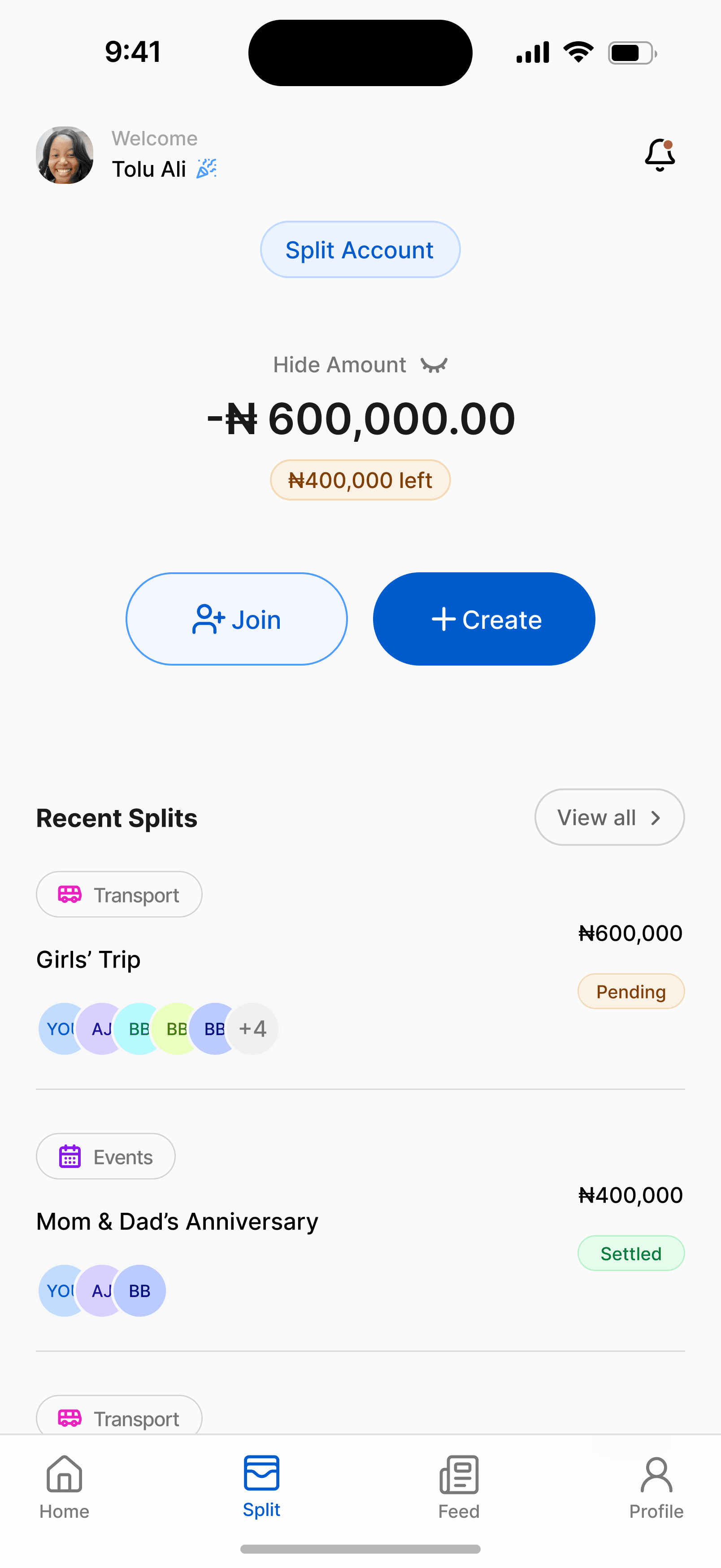


End-to-end flow for splitting a group expense.
Competitive Analysis Report
Overview:
The group payments space has no shortage of tools. But most were optimised for speed or simplicity,
not for the social and emotional complexity of shared money.
This analysis looks at where the market fell short and why Kobo exists.
Competitive Analysis Report
Competitors:
Venmo was built for fast peer-to-peer payments. CashApp for transfers, investing, crypto. Splitwise for tracking who owes what across a group. Each solves a narrow problem well. None of them were designed with group social dynamics
as a core consideration.
Competitive Analysis Report
Privacy issue:
Venmo made financial transactions a public social activity by default. Clinical psychologists link this design decision to anxiety and social exclusion, particularly in younger users. Kobo was built on a different belief: financial trust is private by nature.
Competitive Analysis Report
The Gap:
Splitwise comes closest, but users still have to leave the app to settle up. Venmo and CashApp don't treat groups as a unit at all. No single product had unified expense splitting and settlement inside a group-native experience. That was the gap.
Competitive Analysis Report
Competitive Analysis Report
None of these were designed for communal spending culture. Kobo operates in a market that is culturally primed for group financial tools.



End-to-end flow for sending payment reminders to participants.
End-to-end flow for sending payment reminders to participants.
4 flows. 17 screens. 7 UI states.
Most expense apps design for the money. Kobo was designed to hold money and preserve relationships. The design decisions were made to cover every moment where the group experience could break down.
Payment flow reduced to 4 steps.
Drop-off happens where hesitation lives. The payment flow was stripped to its minimum to get users through the moment they are most likely to abandon. Research shows automated reminders reduce unresolved payment cases by 21%.
Reminders that protect the relationship.
Chasing a friend for money can be uncomfortable. AI-drafted reminders handle the wording. Contribution visibility keeps everyone informed passively. A 48-hour cooldown ensures Kobo never becomes a tool for pressure.
Every critical exit point is closed.
Join. Pay. Remind. Confirmation states were designed for each of these moments specifically. Kobo treats debt as both a financial problem and a relationship problem. No action is left without acknowledgement.





Beyond the Transaction
Fintech features are transactional and social. A product that delivers one without the other has only done half the job. Designing for social context is not a soft concern. It is a product requirement. Kobo is proof that the best fintech products are not just built around money. They are built around people.
Beyond the Transaction
Fintech features are transactional and social. A product that delivers one without the other has only done half the job. Designing for social context is not a soft concern. It is a product requirement. Kobo is proof that the best fintech products are not just built around money. They are built around people.



1:21 AM